You finish a long day at your desk and stand up feeling a familiar tightness. Your shoulders are rounded forward, your neck feels stiff, and there’s a subtle ache between your shoulder blades. Welcome to “Desk Back”—the modern postural plague caused by hours of sitting, staring at screens, and leaning forward.
This posture isn’t just an aesthetic issue; it’s a functional one. Chronically tight chest and neck muscles paired with weak, overstretched back muscles can lead to persistent pain, headaches, reduced breathing capacity, and even increased risk of injury during exercise. The good news is that with consistent, targeted effort, you can counteract these effects. You don’t need a complex routine—just three essential exercises that strengthen what’s weak and stretch what’s tight.
Understanding “Desk Back” (Upper Crossed Syndrome)
The typical desk posture creates muscular imbalances known as Upper Crossed Syndrome. Imagine an “X” across your upper body. On one diagonal, the muscles become tight and overactive: your chest (pecs) and the muscles at the front and base of your neck (upper trapezius and levator scapulae). On the other diagonal, the opposing muscles become weak and underactive: your mid-back muscles (rhomboids, lower traps) and the deep neck flexors at the front of your neck.
Your corrective strategy must be two-pronged: stretch and release the tight muscles in the front, and activate and strengthen the weak muscles in the back. The following three exercises are chosen specifically to address this imbalance efficiently.
Exercise 1: The Doorway Chest Stretch – Release the Front
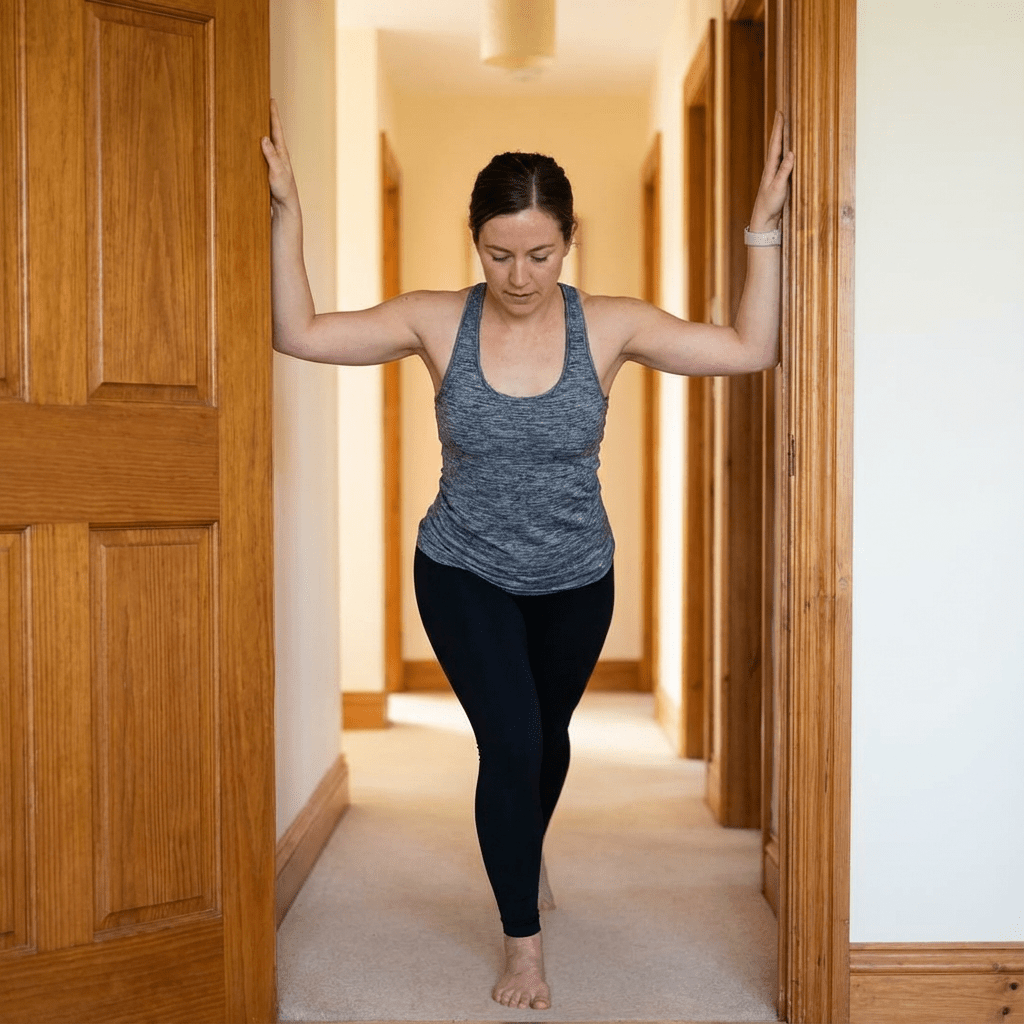
This stretch directly targets the pectoral muscles, which become shortened and tight from reaching forward to a keyboard and mouse all day. Releasing this tension is the first step in allowing your shoulders to sit back in their natural, open position.
Stand in an open doorway. Raise your arms to the sides, bending your elbows to 90-degree angles so your upper arms are parallel to the floor and your forearms point straight up. Place your forearms and palms flat against the door frame. Gently step one foot forward until you feel a deep, comfortable stretch across your chest and the front of your shoulders. Hold this position for 30-60 seconds, taking deep breaths. Avoid arching your lower back excessively; the stretch should be felt in the chest, not the spine.
Perform this stretch 2-3 times throughout the day, especially after long periods of sitting. Consistency is key to regaining length in these tissues.
Exercise 2: The Prone Y-T-W Activation – Wake Up the Back
This series of movements is a powerhouse for activating the weak, dormant muscles of your upper and mid-back—the rhomboids, lower trapezius, and rear deltoids. It teaches your shoulder blades to retract (pull together) and depress (slide down your back), countering the forward, hunched position.
Lie face down on a mat or the floor. You can rest your forehead on a folded towel for comfort. Keep your neck long and in a neutral position, looking down at the floor. For the Y: Extend your arms overhead at a 30-degree angle from your head (forming a “Y” shape) with your thumbs pointing up. Squeeze your shoulder blades together and down as you lift your arms a few inches off the ground. Hold for 2-3 seconds, then lower. For the T: Move your arms out to your sides, forming a “T” shape with your body, palms facing down. Again, lift your arms by squeezing your shoulder blades together. For the W: Bend your elbows and pull them down toward your hips, forming a “W” shape, squeezing your shoulder blades hard at the bottom.
Perform 8-12 slow, controlled reps of each letter (Y, T, W) in sequence. Aim for 2-3 sets. Focus on the mind-muscle connection and the sensation of squeezing between your shoulder blades, not on lifting your arms high.
Exercise 3: The Chin Tuck – Reset Your Neck Alignment
Desk work often leads to “forward head posture,” where your head juts forward, straining the muscles at the base of your skull and neck. The chin tuck strengthens the weak deep neck flexors at the front of your neck and retrains your head to sit directly over your spine.
Sit or stand tall with good posture. Looking straight ahead, place two fingers on your chin. Without tilting your head up or down, gently draw your chin straight back as if you’re making a “double chin.” You should feel a stretch at the base of your skull and a contraction in the front of your neck. Hold the retracted position for 3-5 seconds, then slowly release. Ensure the movement is slow and controlled, not a jerking motion. A common mistake is to tuck the chin and then look down; your gaze should remain level with the horizon throughout the movement.
Perform 10-15 reps, several times a day. This is a subtle but profoundly important exercise for restoring cervical spine alignment and reducing strain.
How to Integrate This Mini-Routine into Your Day
The effectiveness of this approach lies in frequency, not duration. You don’t need a 60-minute workout; you need consistent, brief interruptions to the sitting pattern. Set a timer to remind you every 60-90 minutes. When it goes off, stand up and perform: 30-60 seconds of the Doorway Chest Stretch, 1 set of the Prone Y-T-Ws (8-12 reps each), and 10 Chin Tucks. The entire circuit takes less than 3 minutes. For a more structured approach, do 2-3 full rounds of the three exercises as a dedicated 10-minute routine at the start or end of your day.
The Bigger Picture: Posture is Dynamic
Remember, posture is not a static position you hold, but a dynamic state of readiness. Alongside these exercises, make small environmental tweaks. Ensure your workstation is ergonomic: your screen is at eye level, your knees are at a 90-degree angle, and your elbows are supported. Most importantly, make movement a non-negotiable part of your day. Set an alarm to stand up, walk, and simply change positions every 30 minutes if possible. Your body is designed to move, not to hold a single position for hours on end.
“Desk Back” is a product of your environment, but it doesn’t have to be your permanent state. By diligently stretching the tight front, strengthening the weak back, and retraining your neck position, you can actively reverse the damage of prolonged sitting. These three exercises are your daily maintenance tools—simple, equipment-free, and scientifically targeted.
Start today. The next time you feel that familiar hunch and tightness, don’t just accept it. Get up, find a doorway, and take three minutes to invest in a taller, stronger, and pain-free you.
Which of these three exercises do you feel you need the most? Will you try the mini-break circuit? Share your posture challenges or successes in the comments!



 Fuel & Function
Leave a comment