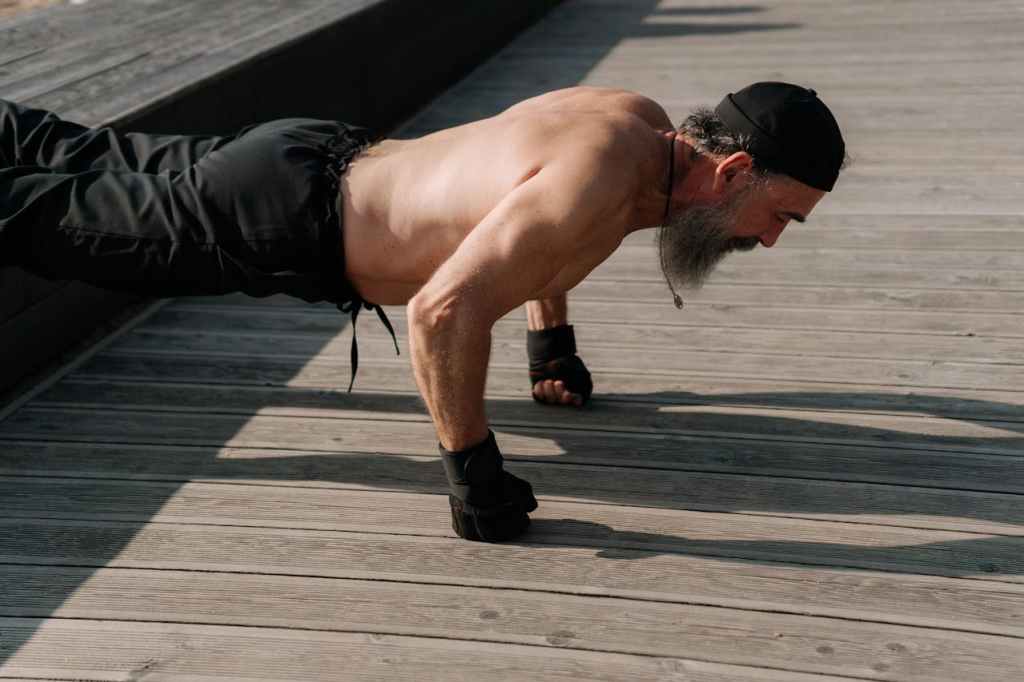
You’re committed to your training, but life gets in the way: a busy schedule, travel, a packed gym, or simply a desire to train outside. The misconception that muscle building requires heavy barbells and stacks of plates can derail progress. The truth is, your body is the ultimate piece of equipment, and with the right knowledge, you can create enough resistance to stimulate significant muscle growth and strength gains anywhere.
The key lies in progression. Just as you add weight to a barbell, you must make bodyweight exercises more challenging. This guide moves beyond basic push-ups and air squats to introduce advanced bodyweight progressions that will test your strength, stability, and coordination, proving you don’t need a gym to get an intense, muscle-building workout.
The Principle of Bodyweight Progression: Making the Impossible, Possible
To build muscle with bodyweight training, you must adhere to the same fundamental rule as weighted training: progressive overload. Since you can’t easily add plates, you manipulate other variables to increase difficulty. The primary methods are leveraging mechanical disadvantage (changing leverage to make your muscles work harder), adding range of motion (moving through a fuller, more challenging path), and mastering unilateral movements (training one limb at a time, which dramatically increases demand on the working side). Mastering progressions is a skill in itself, building exceptional body control and functional strength.
The Advanced Bodyweight Toolkit: Six Game-Changing Progressions
1. The Pistol Squat: The Ultimate Single-Leg Strength Test
The pistol squat is a pure test of lower body strength, mobility, and balance. It requires one leg to squat down until the hamstring touches the calf while the other leg is held straight out in front.
To build towards a full pistol, start with assisted pistol squats by holding onto a door frame or a pole for balance and support as you lower down. The next progression is the elevated pistol squat, where you perform the movement sitting down to a bench or chair, which reduces the depth and makes standing back up more manageable. Once you have the strength and balance, work on the full pistol squat on the floor. Focus on keeping your chest up and extending your non-working leg straight. This movement builds immense strength in your quads, glutes, and stabilizers throughout your core and ankle.
2. The Archer Push-Up and One-Arm Push-Up: Beyond Horizontal Pushing
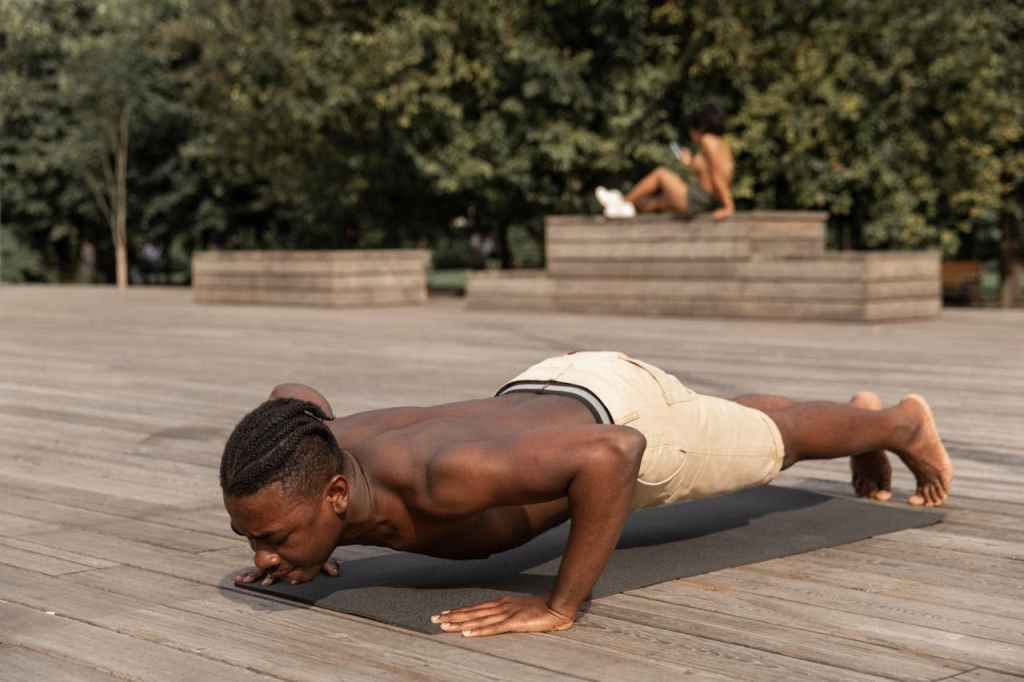
When regular push-ups become too easy, you must increase the load on each arm. The archer push-up is the perfect bridge. From a wide push-up position, lower your body toward one hand while keeping the other arm straight and extended out to the side, creating a “bow and arrow” shape. This places the majority of your bodyweight on the working side.
The ultimate goal is the one-arm push-up. A strict rep requires full body tension, with legs spread for a stable base, a locked core, and a slow, controlled descent and ascent. It is a feat of pure pressing strength and core anti-rotation stability. Both variations intensely work the chest, shoulders, and triceps while engaging the entire core to prevent your body from twisting.
3. The Bodyweight Row Progression to the Front Lever: Mastering Horizontal Pulling
Without a barbell for rows, you need a bar or rings at hip height. Start with standard bodyweight rows, keeping your body straight and pulling your chest to the bar. To progress, elevate your feet to put more of your bodyweight into the pull.
The advanced endpoint of horizontal pulling is the front lever. This is a high-skill move where you hold your body straight and parallel to the ground while hanging from a bar. Build up to it with progression holds: start with a tuck lever (knees pulled to chest), advance to an advanced tuck (shins parallel to ground), then a straddle lever (legs spread wide), and finally work toward the full front lever. This progression builds incredible strength in your lats, upper back, biceps, and core.
4. The Pike Push-Up to Handstand Push-Up: Overhead Pressing Without Weights
To target your shoulders vertically, you mimic the overhead press with bodyweight. Begin with pike push-ups. Get into a downward dog position with your hips high in the air and perform a push-up, lowering the top of your head toward the floor between your hands. As you get stronger, elevate your feet on a bench or box to increase the load.
The pinnacle of bodyweight overhead strength is the handstand push-up (HSPU). Start by practicing holding a chest-to-wall handstand to build comfort and stability. Then, begin performing negative HSPUs by lowering yourself slowly from the handstand to the ground with control. Finally, work on performing full reps, either against a wall for support or freestanding for the ultimate challenge. This movement builds formidable shoulder, tricep, and upper chest strength.
5. The Nordic Hamstring Curl: Unlocking Posterior Chain Strength
The hamstrings are notoriously hard to train without equipment. The Nordic hamstring curl solves this. Kneel on a soft surface with your ankles secured under a sturdy object or with a partner holding them. With your body straight from knees to head, slowly lower yourself forward toward the ground, fighting gravity with your hamstrings the entire way.
Use your hands to catch yourself at the bottom, then push back up to the start. The eccentric (lowering) portion is brutally effective for building hamstring strength and resilience, which is crucial for knee health and athletic power.
6. The Dragon Flag: The Ultimate Core Compression
Made famous by Bruce Lee, the dragon flag is a profound test of total core strength, particularly the often-neglected lower abdominals. Lie on a bench or the floor and grip something stable behind your head. Lift your legs and hips off the ground until your body is in a straight, rigid line at an angle, then lower with control without letting your back arch.
Start with bent-leg dragon flags to reduce the leverage. As you get stronger, work toward holding the straight-body position at the top (the dragon flag “hold”) before attempting the full negative lowering phase. This movement builds a rock-solid, powerful core that translates to every other lift.
Programming Your Advanced Bodyweight Workouts
Structure these moves like a traditional strength session. Aim for 3-4 full-body workouts per week on non-consecutive days. Pair movements wisely: pair a pushing exercise (e.g., Archer Push-Ups) with a pulling exercise (e.g., Bodyweight Rows) in a circuit or as alternating sets. For each exercise, work in a rep range that is challenging, typically 3-5 sets of 3-8 reps for strength-focused moves like pistols or HSPU progressions, and 3-4 sets of 5-12 reps for others. Your progression is now skill-based: when you can hit the top of your target rep range with perfect form for all sets, move to the next progression in the sequence (e.g., from assisted pistol to elevated pistol).
Barbells are tools, not prerequisites. Advanced bodyweight training demands a different kind of strength—one of control, leverage, and mastery over your own mass. By systematically progressing through these challenging movements, you will not only maintain your hard-earned muscle when away from the gym but also develop resilient joints, impressive functional strength, and a newfound respect for what your body can achieve with discipline and creativity.
The barrier to training is now only your knowledge and willpower, not access to equipment.
Which of these advanced bodyweight moves are you excited to tackle first? Have you already mastered one? Share your goals or victories in the comments below!


 Fuel & Function
Leave a comment